Stuck between a Circus and a Horror Show
Europe squeezed between a corrupt and capricious tyrant to its West and a poisonous, paranoid one to its East.

The former German chancellor Angela Merkel was caricatured as Adolf Hitler in the Greek gutter media in 2015 for her tightrope role in steadying the Eurozone and keeping the collapsing Greek economy within it. It was the same year in which she controversially allowed a million refugees into Germany advocating for a more humane European migration policy.
Merkel had told Germans “We can manage this” and to a large degree they did, until the whole thing collided with lurking populism always ready to trigger and then amplify discontent.
A year later Americans elected a caricature for president and Merkel endured Donald Trump’s tantrums beginning with his withdrawal from the Paris Agreement on Climate Change. It was a personal blow for her not just because of the damage to years of painstaking work but because as Helmut Kohl’s minister for the environment, she had convened the very first UN Climate Change Conference in 1995 in Berlin.
There would then be the awkward moment in 2018 when Trump refused to shake hands with her at the White House: “Instead of stoically enduring the scene, I whispered to him that we should shake hands… As soon as the words left my mouth, I shook my head at myself. How could I forget that Trump knew precisely what he was doing… He wanted to create conversation fodder through his behavior, while I had acted as though I were having a discussion with someone completely normal.”
Merkel was used to bullies. Trump refusing a handshake was nothing compared to how uncomfortable she was made to feel in 2007 when Vladimir Putin allowed his large Labrador into their meeting after his staff had been specifically warned that she was afraid of dogs.
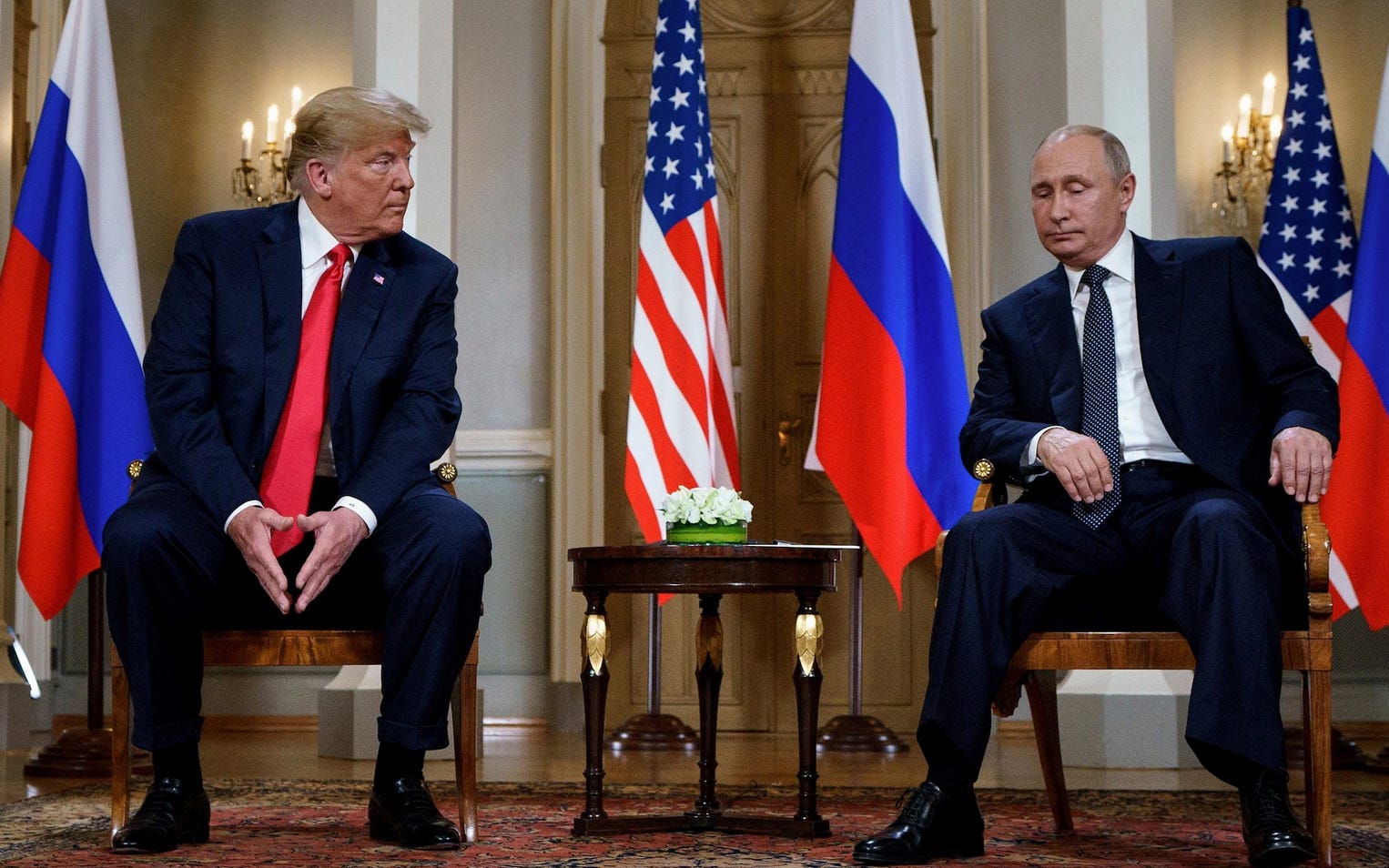
The tactical similarities between Trump and Putin begin to make sense if you go by Merkel’s description of the US president in her recent autobiography: “[Trump] was really fascinated by the Russian president. … I received the distinct impression he was captivated by politicians with autocratic and dictatorial traits.”
Fast forward to February this year and to the humiliation suffered by Volodimir Zelenskyy in the White House and one begins to understand that Trump’s show was put on to impress Putin.
Just four years after Merkel’s departure from the scene Europe is squeezed between these two petty tyrants. A corrupt and capricious one to its West and a poisonous, paranoid one to its East.
To make things worse, it is now a Europe maligned by the absence of real leadership and weakened by the absence of Britain. More ominously, it is a Europe infected by puny Trump-Putin clones, a racket spreading disorder and deceit bolstered by an orchestrated disinformation network with Putin as the silent grand master and Trump as the loud jester.
Russia has no tradition or practical experience of democracy. Scholars have even argued, unfairly if one contemplates the heroism of Boris Nemtsov and Alexei Navalny, that its people prefer the authority of supreme rulers. At the other end, Trump’s betrayal of Ukraine, the suspension of international humanitarian aid and his contemptible treatment of allies means that the United States no longer stands for the old American virtues and the liberal order it once claimed it defended.
The decline had been obvious. The Obama interlude slowed but did not reverse it. Biden paused the slide but, in the end, was swept by it. From as far back as Kissinger’s well disguised ruthlessness to Hegseth’s recent poorly disguised incompetence we knew the US stood for a free world only in name and by selective execution.
What we did not know was how deeply eroded its own democratic structures had become. What we could not expect was the Republican Party’s total collapse exposing the greed of its backers and the ignorance and vulnerability of its supporters. Nothing, however, could have prepared us for the weak reflexes of resistance by the Democratic Party, the media and universities – though not all journalists and not all academics.
So what is Europe to do? Caught between the collapse of institutional order in Washington and a malicious enemy in Moscow, it cannot avoid redefining, even re-inventing itself.
This doesn’t mean that it must forfeit its credentials of moderation, consensus, and multilateralism. But it does mean admitting to the ruinous complacency of its security reliance on the US and finding the moral courage to stand up to him and endure the economic pain that will follow.
It means member states boosting defense by taxing their rich while reversing economic policies that have led voters down populist traps and extreme political choices. It means supporting its youth through better housing policies and re-investing in social services that attend to the needs of humans, not to the demands of markets and public-private-partnership sell outs. It means toughening up on large online platforms and their algorithmic darkness, addressing the inequalities brought by financialization and the blind adulation of big-tech. And, once and for all, stop obsessing over the metric artificiality of growth as the sole arbiter of progress.
Believing in the European project does not mean that you do not recognize the faults that afflict it like its slow complex and self-consuming bureaucracy. But Europe is complicated because sustaining peace and prosperity is a complicated task. Simple, ephemeral and, in the end, dangerous ‘solutions’ are for simpletons like Trump and dictators like Putin. Merkel knew that better than anyone but at the time she played along because of cheap Russian gas and cheap US security. Things have now changed. Post-Ukraine and post-US meltdown there’s an urgency that didn’t exist when Merkel was around.
The European project may have started as a ‘common market’ and evolved into an economic community but now its member states can only survive if they rally their citizenry to believe in a new, tougher single European polity. It may seem counterintuitive but by knocking it out of its comfort zone Trump and Putin have actually done Europe a favour.
Photo: Brendan Smialowski, AFP